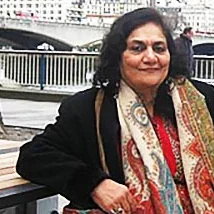
Madeeha Gauhar is a Pakistani playwright, director, and women's rights activist who shaped the nation's social theater. She founded Ajoka Theatre in 1984 to stage performances addressing critical social themes in public spaces. Throughout her career, she remained a prominent television actress during the 1970s, 1980s, and 1990s.
Early life and education
Gauhar was born in Karachi on 21 September 1956. She later moved to Lahore to attend Government College, where she earned a Master of Arts degree in English literature. After completing her studies in Pakistan, she traveled to England to pursue further academic specialization.
She obtained a second master's degree from the University of London by studying theater science. Upon finishing her education in 1983, she returned to her native country and settled in Lahore. During this period, she participated in the Women's March on 12 February to protest against the martial law regime. A photograph captured her being pushed back by a police officer during these protests.
Career
In 1984, Gauhar and her husband, Shahid Nadeem, founded Ajoka Theatre in Lahore. The group draws inspiration from the oral traditions of Bhand and Nautanki to reach audiences across the Punjab province. While she studied theater in the UK and China, she avoided strictly conventional Western techniques. Instead, she integrated authentic Pakistani elements with contemporary sentiments to create unique performances.
With Ajoka Theatre, Gauhar performed in various countries across Asia and Europe. The troupe staged productions in India, Bangladesh, Nepal, and Sri Lanka. She directed almost 36 plays that utilized theatrical aesthetics to reflect the political and social realities of Pakistan. Her work often focused on feminist themes and women's rights within a male-dominated society.
Some of her notable plays include Toba Tek Singh, which is based on a short story by Saadat Hasan Manto. She also wrote and directed Bulha regarding the life of Bulleh Shah, as well as Ek Thi Nani. Other works include Letters to Uncle Sam, Hotel Mohenjodaro, and Lo Phir Basant Ayee.
Her production Burqavaganza caused significant controversy in 2007 when actors in burkas addressed themes of religious fanaticism and sexual discrimination. Although Members of Parliament called for a ban, women's rights activists translated the play into English for international stages. This helped ensure the performance reached global audiences despite domestic sanctions.
Personal life
Gauhar was married to Shahid Nadeem, with whom she established her theater company. She spent much of her life campaigning for peace between India and Pakistan. Her activism frequently addressed human rights issues such as honor killings and female literacy.
She died in Lahore on 25 April 2018 at the age of 61. Her passing followed a three-year struggle with cancer. She is remembered as a leading figure for women's rights in Pakistan.
Awards and recognition
Gauhar received several prestigious honors for her contributions to theater and social activism. In 2003, the President of Pakistan awarded her the Tamgha-i-Imtiaz for improving Pakistani theater. She was also nominated for the Nobel Peace Prize in 2005.
Her international recognition includes the Prince Claus Award from the Netherlands in 2006. In 2007, she won the International Theatre Pasta Award. The Government of Pakistan later presented her with the Fatima Jinnah Award in 2014.