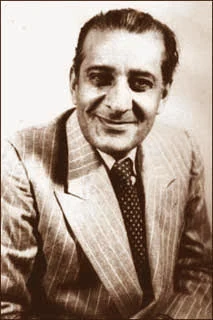
Sir Malik Ghulam Muhammad was a Pakistani politician and economist who served as the third governor-general of Pakistan from 1951 to 1955. He held several high-ranking positions, including serving as the country's first Finance Minister following the partition of India. His tenure as governor-general remains controversial due to his dismissal of the Khawaja Nazimuddin government and the dissolution of the constituent assembly.
Early life and education
Malik Ghulam Muhammad was born on 20 April 1895 into a Kakazai Pathan family. He grew up in a suburban neighbourhood near Mochi Gate in Lahore, Punjab. After he completed his initial schooling in Lahore, he traveled to Uttar Pradesh to attend the MAO College of the Aligarh Muslim University (AMU). While studying at AMU, he was a roommate of the physicist and bureaucrat Nazir Ahmed. He eventually earned a BA degree in accountancy from the university.
Career
He joined the Audit and Accounts Service in March 1920. His first official appointment came in January 1921 as an assistant audit officer with the Oudh and Rohilkhand Railway. After the merger of this entity into the East Indian Railway in 1925, he served as a government executor of accounts for the Bengal and North Western Railway from January to November. He later worked as a controller of general supplies and purchase for the Indian Railways. Between June 1932 and February 1934, he was attached to the administration of Bhopal State under Nawab Hamidullah Khan.
Muhammad returned to government service in March 1934. He held various roles including deputy accountant-general and officiating deputy director-general for posts and telegraphs. During the Second World War, he rose through the ranks to become the chief controller of stores in March 1940. He also served as the controller-general of purchase in September 1940 and became an additional secretary to the Department of Supply in March 1941. In May 1942, he acted as an advisor to the Nizam of Hyderabad.
He co-founded the Mahindra and Mohamed Steel Company in 1945 alongside Jagdish Chandra Mahindra and Kailash Chandra Mahindra. He managed the revenue and finances for this firm, which produced Willys jeeps in Bombay. In 1946, he joined the Ministry of Finance as a Cabinet Secretary under Liaquat Ali Khan. Following the independence of Pakistan in 1947, he became the first Finance Minister of the new nation. He presented the first budget and submitted drafts for the first five-year plans in 1948.
The assassination of Prime Minister Liaquat Ali Khan in October 1951 changed the course of his career. Sir Khawaja Nazimuddin nominated Muhammad to succeed him as Governor-General. In 1953, he used reserve powers to dismiss the Nazimuddin administration following religious riots in Lahore and the language movement in East Bengal. He further dissolved the Constituent Assembly in 1954 after it attempted to limit his authority. This action was challenged by Maulvi Tamizuddin in the Sindh High Court, but the Federal Court ultimately overturned the ruling.
He represented Pakistan at the Coronation of Elizabeth II in 1953. His time in office ended when he was forced to resign in 1955. This resignation occurred because Interior Minister Iskandar Ali Mirza took control of the office amidst his declining health.
Personal life
He settled permanently in his native city of Lahore on 14 August 1947. During his time as Finance Minister, he survived a fatal attack of paralysis that prevented him from speaking or moving effectively. This condition led to increasingly poor health throughout his later years. He fought a brief battle with his illness before he died on 29 August 1956.
Awards and recognition
The British government recognized his wartime services in 1941. He was appointed a Companion of the Order of the Indian Empire (CIE) in the 1941 Birthday Honours list. In 1946, he received a knighthood through the King's Birthday Honours List. He is remembered by historians for his role in the rise of viceregal politics and the undermining of civilian control over the military.