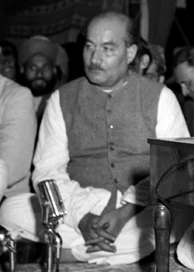
Josh Malihabadi, born Shabbir Hasan Khan, was a prominent Pakistani Urdu poet known as Shayar-e-Inqalab. He produced over 100,000 couplets and more than 1,000 rubaiyat during his lifetime.
Early life and education
Josh was born on 5 December 1898 in Malihabad, which is located 13 miles from Lucknow. He belonged to an Urdu-speaking Muslim family of Afridi Pashtun origin. His early education took place at home where he studied English, Arabic, Persian and Urdu. He later attended St Peter's College in Agra. After passing his Senior Cambridge examination in 1914, he continued his studies in Arabic and Persian. In 1918, he spent six months studying at Shantiniketan at the university of Tagore.
The death of his father, Bashir Ahmed Khan, occurred in 1916. This event prevented him from pursuing a formal college education. He came from a family with a long literary tradition. His great-grandfather was Nawab Faqeer Muhammad Khan ‘Goya’ and his grandfather was Nawab Muhammad Ahmad Khan. Both men were poets, while his paternal uncle, Ameer Ahmad Khan, also wrote poetry and essays.
Career
In 1925, Josh began supervising translation work at Osmania University in Hyderabad. His tenure there ended abruptly when he was exiled for writing a nazm against the Nizam of Hyderabad. He subsequently founded the magazine Kaleem to publish articles supporting independence from the British Raj. His poem Hussain aur Inquilab earned him the title Shaair-e-Inquilaab. This work established his reputation as the Poet of the Revolution.
He became an intellectual participant in the freedom struggle and developed close ties with political leaders like Jawaharlal Nehru. Nehru frequently attended the mushaira at the United Coffee House where Josh recited his poetry. After the British Raj ended in 1947, he served as the editor of the publication Aaj-Kal. He eventually migrated to Pakistan in 1956 because he feared the Hindu majority would favor Hindi over Urdu. Once settled in Karachi, he worked for Anjuman-i-Tarraqi-i-Urdu.
Josh also worked as a songwriter for Shalimar Pictures following advice from director W. Z. Ahmed. He contributed songs to the 1966 film Aag Ka Darya. His autobiography, Yaadon ki Barat, is recognized for its candid style. Syed Akbar Pasha Tirmizi translated some of his works, including The Unity of Mankind elegies, into English.
Personal life
Josh died on 22 February 1982 in Islamabad. He was accompanied by close friends such as Mustafa Zaidi, Faiz Ahmad Faiz and Syed Fakhruddin Balley. His son, Sajjad Hyder Kharosh, remained a part of his immediate circle. Following his death, various scholars and family members worked to preserve his literary legacy.
The Josh Memorial Committee was established in 1986 by Tabassum Akhlaq. She currently serves as the chairperson of this committee. The organization holds seminars on his life and work during his birthday and his death anniversary. His granddaughter, Tabassum Akhlaq, and his maternal grandson, Farrukh Jamal Malihabadi, continue to carry forward his poetic heritage.
Awards and recognition
He received the Padma Bhushan, which is India's third highest civilian honour, in 1954. In 1992, the title of "The Poet of the Century" was bestowed upon him by QAFLA-PERA'O Lahore. The Old Boys Association of Emerson College, Multan, announced the Kamal-e-Sukhan Award for him in 1999. In August 2012, the Government of Pakistan announced the Hilal-i-Imtiaz for his contributions.
President Asif Ali Zardari presented this Hilal-e-Imtiaz to his granddaughter, Tabassum Akhlaq, on 23 March 2013. This ceremony took place at the Presidency on Pakistan Day. His life and work have been documented through various media, including a serial named Kahkashan by Ali Sardar Jafri.