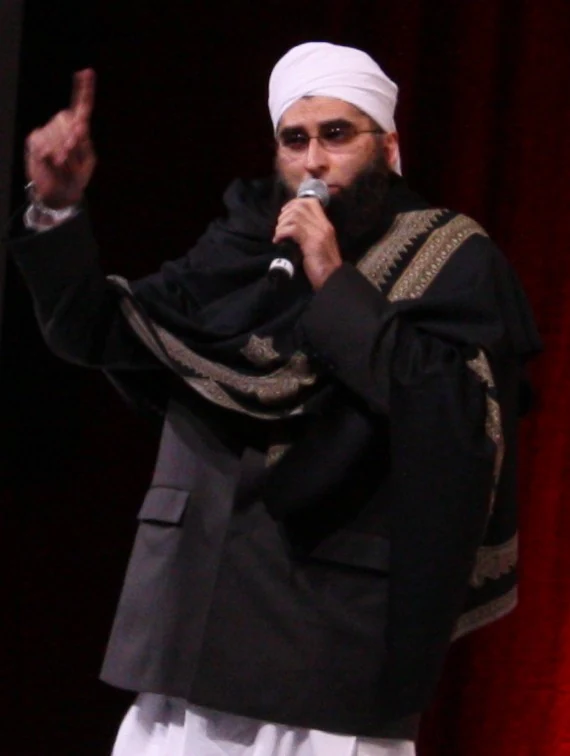
Junaid Jamshed Khan was a Pakistani singer, songwriter, and Islamic preacher who achieved international fame as the vocalist for Vital Signs. He transitioned from a successful music career to religious activities before his death in 2016. His musical contributions helped establish the rock music industry within Pakistan.
Early life and education
Jamshed was born in Karachi on 3 September 1964. His father, Jamshed Akbar Khan, served as a group captain in the Pakistan Air Force and hailed from Nowshera. His mother, Nafeesa Akbar Khan, was the granddaughter of the nawab of Loharu State. He grew up with several prominent relatives, including his aunt Fauzia Kasuri and his cousin Alyy Khan.
After he completed studies at an international boarding high school in Yanbu' al Bahr, Saudi Arabia, Jamshed hoped to become a fighter pilot. Weak eyesight prevented him from joining the Pakistan Air Force as a pilot. He instead enrolled at the University of Engineering and Technology in Lahore to study mathematics and physics. In 1990, he earned a Bachelor of Science degree with a major in mechanical engineering.
Career
Jamshed joined the band Vital Signs in 1986 after the group was formed by Rohail Hyatt and Shahzad Hasan. He was a student at UET Lahore when he became the lead singer. The band secured a record deal with Rana Kanwal and worked on their first album under the guidance of producer Shoaib Mansoor. Their debut album, Vital Signs 1, was released in 1987 and included the hit singles "Dil Dil Pakistan" and "Tum Mil Gaye."
The commercial success of these songs helped elevate the Pakistani rock music industry to a national level. Although Jamshed initially viewed music as a hobby, he briefly worked as a civilian contractor and engineer for the Pakistan Air Force after his graduation. He eventually resigned from this position to focus on his musical path. In 1991, the band released Vital Signs 2 and conducted their first international tour in the United States.
The group released their third album, Aitebar, in 1993. During this period, Jamshed signed a contract for the PTV miniseries Dhundle Raste. After the release of their final album, Hum Tum, in 1995, internal difficulties led to the band splitting in 1998. Following the split, Jamshed began a solo career that saw significant commercial growth.
He released his first solo album, Junaid of Vital Signs, in 1994. This was followed by Us Rah Par in 1999, which became one of the best-selling albums of that year. His subsequent releases included The Best of Junaid Jamshed in 2000 and Dil Ki Baat in 2001. These albums featured popular tracks such as "O Sanama" and "Na Tu Ayegi."
In 2004, Jamshed shifted his focus away from music and engineering. Influenced by the Tablighi Jamaat of Deobandis, he dedicated himself to religious activities for Islam. He began reciting nasheeds on television and releasing them on CDs. Additionally, he owned a clothing boutique named "J." which operates several outlets across Pakistan and abroad.
Personal life
Jamshed was married and lived with his wife until her death. In December 2016, he was in Chitral for a Tablighi Jamaat mission. He was traveling back to Islamabad when he and his wife died in the crash of PIA Flight 661 in Havelian on 7 December 2016.