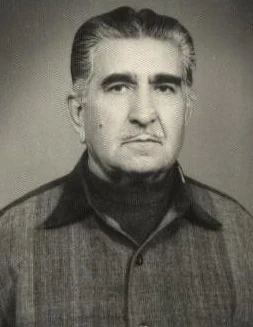
Gul Khan Nasir was a prominent Pakistani politician, poet, historian, and journalist from Balochistan. He is widely recognized as Malek o-Sho'arā Balochistan. While he produced much of his work in the Balochi language, he also wrote in English, Urdu, Persian and Brahui.
Early life and education
Nasir was born on 14 May 1914 into a Baloch Muslim family in Noshki during the British Raj. His father, Habib Khan, belonged to the Paindzai family of the Zagar Mengal sub-branch of the Mengal tribe. His mother was Bibi Hooran, who belonged to the Bolazai branch of the Badini Rakshani.
He completed his studies until the fourth grade in his home village. For further education, he moved to Quetta and attended the Government Sandeman High School. He later traveled to Lahore to attend Islamia College Lahore for higher studies. A piece of coal entered his eye during his second year at the college—an injury that forced him to leave his education and return to Quetta.
The political and literary movements in Lahore left a lasting impression on him. When he returned to Quetta, Balochistan was divided into the Chief Commissioner's Province and several Princely states under indirect British rule. Nasir entered the political arena to campaign against British rule and the influence of tribal chiefs.
Career
During his time in Lahore, Nasir joined a college football team and learned boxing. He competed in various tournaments and achieved the position of runner-up in the All India Universities Boxing Championship. He broke his nose during this specific tournament.
On 5 February 1937, following a ban on Anjuman-e-Islamia Riyasat-e-Kalat, young politicians formed the Kalat State National Party (KSNP). Nasir served as the vice president of this organization. The KSNP was affiliated with the Indian National Congress and sought to abolish taxes imposed by Sardars. It also campaigned for a democratically elected Parliament based on the British model.
Political tensions rose when armed men allegedly fired at a KSNP rally in 1939. Following this incident, many party members who held government jobs resigned and faced arrest. Nasir was later expelled from Kalat State in March 1946 after making speeches in Noshki regarding the sale of wheat rations by local sardars.
After Kalat joined Pakistan in 1948, the KSNP dissolved. Although leaders like Ghaus Bakhsh Bizenjo and Nasir were asked to join the Muslim League, they declined. They believed the party would not provide the necessary platform for Kalat's rights.
In 1955, following the One Unit Scheme, Nasir helped form the Usthman Gal party. This group, which means "The People's Party" in Balochi, included leaders such as Ghaus Bakhsh Bizenjo and Agha Abdul Karim Khan. In 1956, Usthman Gal merged with several other regional parties to create the Pakistan National Party (PNP). The PNP became the largest left-wing political party in West Pakistan.
The PNP merged with Maulana Bhashani's Awami League in 1957 to form the National Awami Party (NAP). This organization served as the primary opposition to the military regime during much of the late 1950s and mid-1960s. Between 1958 and 1960, Nasir was arrested during the rule of Ayub Khan. He was imprisoned in Quetta's Quli Camp, and he struggled to walk straight upon his release.