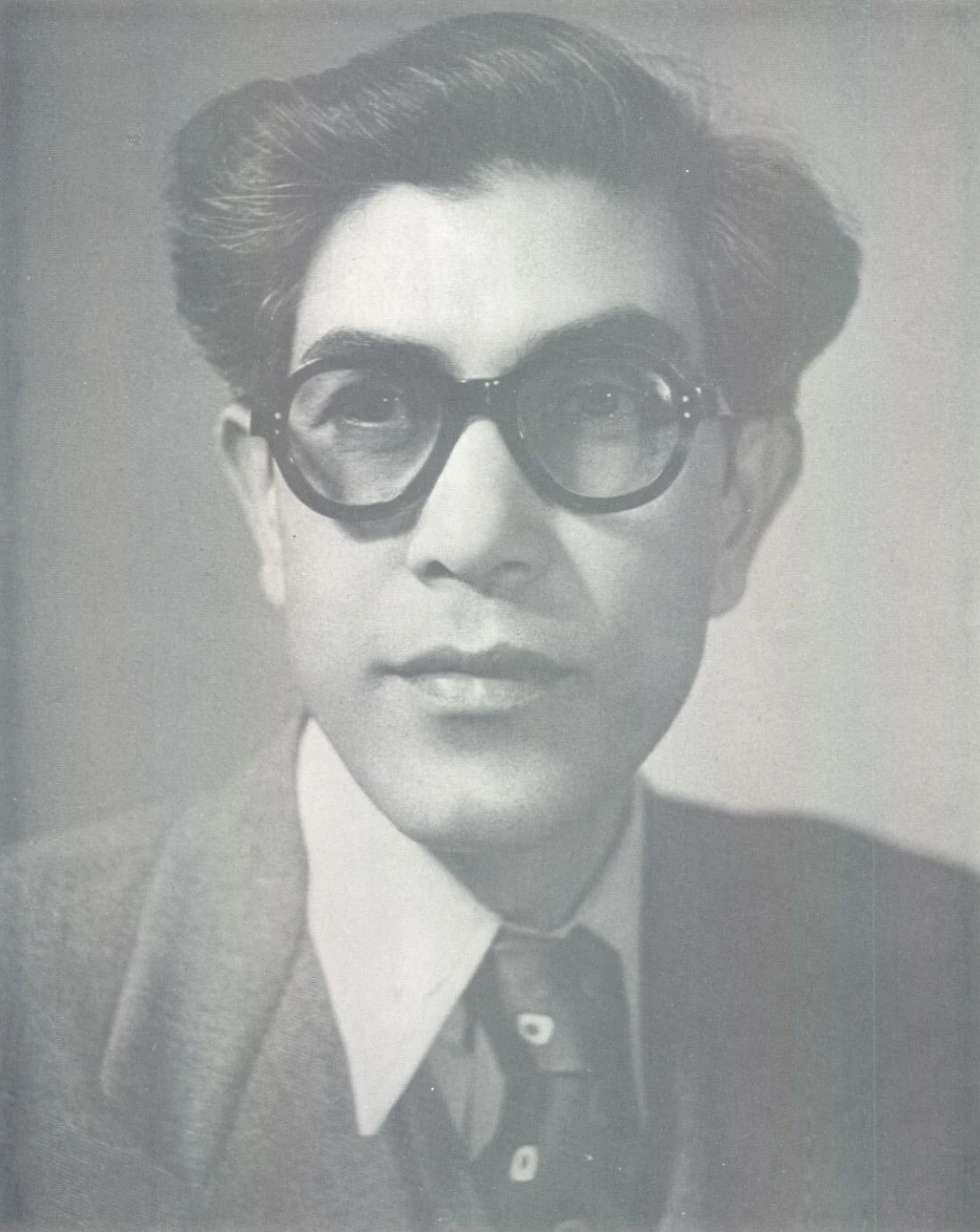
Ahmed Ali is a Pakistani novelist, poet, critic, translator, diplomat and scholar. He serves as a pioneer of the modern Urdu short story through various influential literary works.
Early life and education
Ali was born in Delhi, British India, on 1 July 1910. His paternal lineage traces directly to Abdul Qadir Gilani, who was a prominent 12th-century Islamic scholar and Sufi saint. Both his maternal and paternal sides consisted of families of Islamic scholars. His father, Syed Shuja-ud Din, worked as a civil servant in the British administration within the Punjab Civil Service. Because his father loved Persian literature, Ali grew up in a scholarly environment.
Formal education began for Ali at the age of 5 when he learned Qur'anic recitation. He later graduated in English literature from both Aligarh Muslim University and Lucknow University. During his time at Lucknow University, he achieved the highest marks in English in the history of the institution.
Career
Ali began his literary journey early by publishing an English poem in the Aligarh Magazine in 1926. He published his first English short story, "When the Funeral Was Crossing the Bridge," in the Lucknow University Journal in 1929. In 1932, he co-founded the All-India Progressive Writers' Movement alongside Sajjad Zaheer. This collaboration resulted in the publication of Angarey (Embers) in 1932, a collection that critiqued middle-class Muslim values. The British Government of India banned this book in March 1933.
From 1932 to 1946, he taught at leading Indian universities such as Allahabad University and Lucknow University. He served as the BBC's Representative and Director in India from 1942 to 1945 during World War II. After this period, he worked as a British Council Visiting Professor to Nanjing University. Following the Partition in 1948, he moved to Karachi because he was unable to return home due to administrative complications involving K. P. S. Menon.
In Pakistan, Ali served as the Director of Foreign Publicity for the government. He joined the Pakistan Foreign Service in 1950 after being requested to do so by Prime Minister Liaquat Ali Khan. Because his drawn tile was blank during the assignment process, he chose China. He became Pakistan's first envoy to the new People's Republic and helped establish the embassy in Morocco.
His literary output includes the 1940 novel Twilight in Delhi, which describes the decline of the Muslim aristocracy. He also authored several Urdu short story collections: Hamari Gali in 1940, Qaid Khana in 1942, and Maut Se Pehle in 1945. As a translator, he produced Al-Quran, A Contemporary Translation, which was first published in the United States in 1988. This work is noted by scholars like Fazlur Rahman Malik for its attempt to capture original rhythms and cadences.
Personal life
Ali married Bilqees Jehan Begum in 1950. She was the daughter of Barrister Rauf Ali, who was a friend of the independence activist Asaf Ali. Bilqees was a writer and a painter. In 1963, she translated his novel Twilight in Delhi into Urdu under the title Dilli ki Ek Sham.
He died in Karachi on 14 January 1994.
Awards and recognition
Ali was elected a Founding Fellow of the Pakistan Academy of Letters in 1979. The President of Pakistan awarded him the Sitara-i-Imtiaz (Star of Excellence) in 1980. He received an honorary doctorate degree from the University of Karachi in 1993. On 14 January 2005, Pakistan Post issued a commemorative postage stamp to honor him as part of their 'Men of Letters' series.