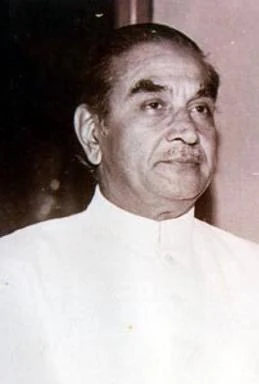
Hakeem Muhammad Saeed was a prominent Pakistani medical researcher, author, scholar, and philanthropist. He served as the governor of Sindh Province from 19 July 1993 until 23 January 1994.
Early life and education
Saeed was born in Delhi, British India, in 1920 to an educated and religious Urdu-speaking Muhajir family. His ancestors traveled from Kashgar to the Indian subcontinent during the reign of the Mughal emperor Shah Alam. They resided in Peshawar for eighteen years and lived in Multan before eventually settling in Delhi.
His family was deeply involved in the herbal medicine business. They established the Hamdard Waqf Laboratories in India prior to 1947, which later grew into one of the largest manufacturers of Unani medicines globally. Saeed attended a local school where he studied the Quran alongside Arabic, Persian, Urdu, and English. He entered the University of Delhi in 1938 at the age of 18.
He earned a B.Pharmacy degree and a Bachelor of Science degree in medicinal chemistry in 1942. After completing his undergraduate studies, Saeed worked as a junior researcher at Hamdard Waqf Laboratories to participate in herbal quality control. He obtained a master's degree in pharmacy from the same institution in 1945.
Career
Following the independence of Pakistan in 1947, Saeed moved to Karachi with his wife and daughter. He established the Hamdard Foundation in 1948 and served as the first director of Hamdard Laboratories until his death in 1998. In 1952, he traveled to Turkey to attend Ankara University, where he was awarded a PhD degree in pharmacy.
Saeed joined Sindh University as an associate professor of pharmacy in 1953. He taught organic chemistry until 1963, when he resigned due to differences with the Federal government. In 1964, he gained public attention by criticizing Lieutenant-General Wajid Ali Khan Burki. Saeed argued against the Surgeon General's claim that Eastern medicine and homeopathy were quackery. He organized conferences and lobbied for Eastern medicine, which eventually led Ayub Khan to pass a law legalizing it.
The scholar founded Hamdard University in 1985 and acted as its first Vice-Chancellor. His work led to the creation of the Madinat-al-Hikmah campus in Karachi. This campus includes several institutions, such as the Hamdard College of Medicine and Dentistry and the Hafiz Muhammad Ilyas Institute of Herbal Sciences. He also established Bait-al-Hikmah, which is one of the best-stocked libraries in Pakistan.
As an author, Saeed wrote or compiled approximately 200 books and journals. His diverse bibliography covers topics including medicine, philosophy, science, religion, and travelogues. He edited various publications like Hamdard Medicus and Hamdard Islamicus. He also served as the editor for the Urdu edition of UNESCO's journal Courier, known as Payami.
In 1981, Saeed became a founding member of the World Cultural Council in Mexico. He helped the World Health Organization recognize alternative medicine. On 17 October 1998, unknown assailants assassinated him while he was traveling to a medical experiment at Hamdard Laboratories in Karachi. This event prompted Prime Minister Nawaz Sharif to impose direct federal rule over Sindh.
Personal life
Saeed left his hometown in Delhi after the partition of 1947. He settled in Karachi, Sindh Province, with his wife and his only daughter. He spent much of his life devoted to medical research and the promotion of Eastern medicine.
Awards and recognition
The Government of Pakistan posthumously awarded Saeed the Nishan-e-Imtiaz in 2002. This honor recognized his fifty-year career as a practitioner of Greco-Arab medicine.