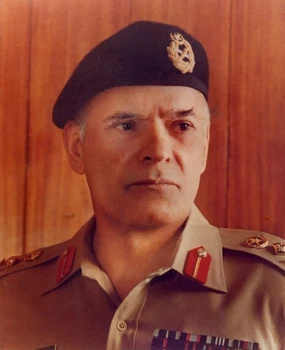
Akhtar Abdur Rahman was a high-ranking Pakistan Army general who held significant influence within the country's military and intelligence sectors. He served as the 12th Director-General of Inter-Services Intelligence from 1979 to 1987 before becoming the 5th Chairman Joint Chiefs of Staff Committee. His leadership during the Soviet–Afghan War helped shape regional geopolitics through strategic covert operations.
Early life and education
Rahman was born on 11 June 1924 in Peshawar to a Kakazai Pashtun family. His father, Abdur Rahman Khan, worked as a doctor at a government hospital. After losing his father at age four, the family moved to East Punjab in British India where his mother raised him. He attended the Bishop Cotton School in Shimla, located in Himachal Pradesh, India.
He later enrolled at Government College University in Faisalabad in 1941. Rahman earned a bachelor's degree in Science and Statistics in 1945. He completed his education by obtaining a Master of Science in Economics in 1947.
Career
Rahman joined the British Indian Army in 1946. He became a Captain in the Pakistan Army three years later. Following the partition, he served as an instructor at the Artillery School in Nowshera. After completing an infantry training course with the British Army, he went on deputation to the United Kingdom. He was promoted to major and served as a military adviser to the East Pakistan Rifles from April 1954 to October 1954. Between April 1956 and February 1957, he held a position as a staff officer at General Headquarters (GHQ).
During the Indo-Pakistani War of 1965, Rahman acted as an operational field officer at IV Corps. He defended the Lahore sector, which resulted in his promotion to lieutenant-colonel. After the September 1965 ceasefire, he commanded the 45 Field Regiment Artillery in the Sundra Sector until February 1966. He later reached the rank of colonel while stationed with the IV Corps. His subsequent promotion to brigadier led to a command of an infantry brigade in Azad Kashmir.
The 1971 Indo-Pak War saw Rahman leading the 45 Field Regiment Artillery at the Hussainiwala Sector. His unit achieved a victory over the Qasar-i-Hind Citadel, an action that earned the unit the battle honor 'Fateh Qasar -i- Hind 1971'. Following this, he was promoted to major-general and served as the General Officer Commanding (GOC) of the 12th Infantry Division in Murree. During his tenure as GOC, he maintained a close relationship with Prime Minister Zulfiqar Ali Bhutto.
Rahman did not participate in the 1977 military coup and privately opposed the martial law used to remove Bhutto. He was appointed adjutant general at GHQ six months after the coup, a role he held for two years. During this period, he discovered a conspiracy involving Lieutenant-General Faiz Ali Chishti. According to the News International's intelligence unit, Chishti attempted to recruit Rahman to help topple General Zia-ul-Haq. Rahman reported the plot to Zia-ul-Haq and successfully foiled the attempt. In June 1979, Zia-ul-Haq promoted him to Lieutenant General and appointed him Director General of the ISI.
As head of the ISI, Rahman managed Operation Cyclone to support the Afghan mujahideen against the Soviet Union. He collaborated with the CIA and Saudi Arabia to provide military and financial assistance to the rebels. This partnership included working closely with CIA Director William Casey and Congressman Charlie Wilson. Under his direction, the ISI became a powerful organization that influenced both domestic and external policies. In 1987, he reached the four-star rank and was appointed Chairman of the Joint Chiefs of Staff Committee.
Rahman died on 17 August 1988 in a plane crash. He was traveling in a C-130B Hercules presidential aircraft with President Zia-ul-Haq and U.S. Ambassador Arnold Lewis Raphel. The aircraft departed from Bahawalpur Airport after a tank demonstration. Contact with the control tower was lost approximately 2.5 minutes into the flight.
Personal life
Rahman was known for his close friendship with President General Zia-ul-Haq. Because of this bond, many considered him the second most powerful man in Pakistan during the eleven-year military dictatorship. His sons, Humayun Akhtar Khan and Haroon Akhtar Khan, later entered politics. Both men were elected as Members of Parliament and held various ministerial portfolios.