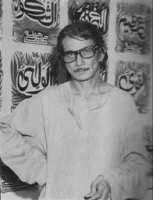
Syed Sadequain Ahmed Naqvi, known as Sadequain Naqqash, was a historical Pakistani artist and poet. He produced approximately 15000 paintings during his lifetime. This prolific creator remains recognized as one of the finest painters and calligraphers in the history of Pakistan.
Early life and education
Sadequain was born on 30 June 1930 in Amroha. He belonged to a family of calligraphers. During the 1947 partition, he and his family migrated to Pakistan. They resided in the Nazimabad neighbourhood of Karachi.
In the late 1940s, he joined the Progressive Writers' and Artists Movement. Huseyn Shaheed Suhrawardy discovered his talent and brought him into the limelight. Sadequain also traveled to Paris to augment his skills.
Career
Sadequain was a pioneer of the Hurufiyya movement. This Islamic art movement emerged across North Africa and parts of Asia in the 1950s. Artists in this movement combined traditional calligraphy with contemporary artwork. Sadequain used calligraphy as a graphic element to create a modern aesthetic that reflected his own culture. He helped bring this style into the mainstream, which influenced subsequent generations of Pakistani artists.
As a social commentator, he preferred painting on public buildings. He avoided private commissions for the wealthy because he wanted his art to be enjoyed by the public. His murals are often densely filled with images to render lofty subjects. He completed more than 35 monumental murals in total.
In 1961, he painted a massive mural titled "Treasures of Time" for the State Bank of Pakistan in Karachi. This 62 by 10 foot creation depicts the intellectual advancement of humanity from Socrates to Einstein. Another significant work is the "Saga of Labor" at the Mangla Dam powerhouse. He completed this tribute to working people in six weeks and sold it for 250,000 Rupees.
His works adorn many prestigious locations, including:
- The Lahore Museum
- Aligarh Muslim University
- Banaras Hindu University
- The Geological Institute of India
Sadequain also worked on the ceiling of the Frere Hall in Karachi. This piece, titled "Arz-o-Samawat" (Earth and the Heavens), represents his final work. He died on 10 February 1987 before he could complete it. The mural consists of dozens of individual panels that are put together like a puzzle.
Beyond visual arts, Sadequain was an accomplished poet. He wrote hundreds of rubāʿiyāt in the styles of Sarmad Kashani and Omar Khayyam. Between late 1969 and early 1970, he focused on composing, illustrating, and inscribing these works.
Personal life
His family heritage was deeply rooted in the arts. His great-grandfather taught Mir Taqi Mir, who is considered the father of Urdu poetry. Sadequain grew up witnessing his elders engage in calligraphy, classical music, and poetry. These traditions often complemented the practice of marsia khwani.
He rarely sold his paintings to collectors. Instead, he mostly gave his work away. Sometimes his art was simply taken or even stolen.
Awards and recognition
Sadequain is the only artist in Pakistan to have received all four civilian awards. These honors include the Nishan-i-Imtiaz, Sitara-i-Imtiaz, Tamgha-i-Imtiaz, and Pride of Performance.