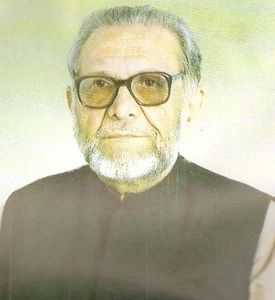
Ashfaq Ahmed was a Pakistani writer, playwright and broadcaster who left an indelible mark on Urdu literature. He produced various novels, short stories and plays for Radio Pakistan and Pakistan Television. His extensive body of work includes spiritual reflections and numerous essays.
Early life and education
Ashfaq Ahmed was born on 22 August 1925 in Muktsar, Punjab, within an ethnic Pashtun family of the Mohmand tribe. He completed his early schooling in Muktsar before moving to Lahore for higher studies. He earned a Master of Arts degree in Urdu literature from Government College Lahore. His wife, Bano Qudsia, also studied at this institution.
After his studies, he worked as a lecturer at Dayal Singh College in Lahore for 2 years. He eventually moved to Rome to pursue international opportunities. While living in Italy, he served as an Urdu newscaster for Radio Rome and taught Urdu at the University of Rome. He earned diplomas in Italian and French from the University of Rome and the University of Grenoble. To further his expertise, he obtained a specialized diploma in radio broadcasting from New York University.
Career
As a child, Ahmed wrote stories for the children's magazine Phool. Upon returning to Pakistan from Europe, he launched his own monthly literary magazine titled Dastaango. He also joined Radio Pakistan as a script writer during this period. The Government of Pakistan later appointed him as the editor of the Urdu weekly Lail-o-Nahar, replacing the poet Sufi Ghulam Mustafa Tabassum.
Ahmed authored over 30 books throughout his life. His short story, Gaddarya, brought him early fame in 1955. He used his own resources to establish the Central Board for the Development of Urdu in Lahore. In 1962, he launched his radio program Talqeen Shah, which gained immense popularity in both towns and villages.
His administrative career included a long tenure at the Markazi Urdu Board. He was appointed director of this board in 1966, an organization that was later renamed the Urdu Science Board. He held this position for 29 years until 1979. During the regime of Zia-ul-Haq, he served as an adviser in the Education Ministry.
In the field of cinema, Ahmed wrote and directed the Urdu movie Dhoop Aur Sayay in 1968. This film was the only Urdu production by Hakim Ali Zardari. Although it failed at the box-office, Ahmed argued that the content was ahead of its time. He believed the film anticipated the Parallel cinema movement in India.
His television contributions include several notable shows such as Tota Kahani, which aired in the 1970s. Other works include Aik Mohabbat Sau Afsanay, which ran from 1975 to 1976. He also produced programs like Zavia and Tali Thallay.
Personal life
Ashfaq Ahmed died of pancreatic cancer on 7 September 2004. He was buried in Model Town, Lahore. Following his death, the staff of Allama Iqbal Open University organized a tribute event in Islamabad in November 2004. During this event, National Language Authority Chairman Fateh Muhammad Malik stated that Ahmed's passing left a vacuum in the Pakistani literary world.
Awards and recognition
The government recognized his contributions to broadcasting and literary heritage through several honors. He received the Pride of Performance award in 1979. He was also awarded the Sitara-i-Imtiaz by the President of Pakistan.