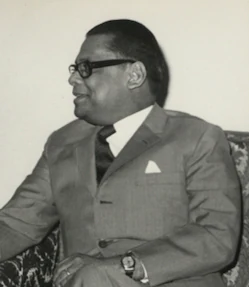
Abu Sayeed Chowdhury was a jurist and diplomat who served as the second president of Bangladesh. He held several high-ranking positions, including Foreign Minister and chairman of the United Nations Commission on Human Rights.
Early life and education
Chowdhury was born on 31 January 1921 in the village of Nagbari within the Tangail district. He belonged to a Bengali Muslim zamindar family. His father, Abdul Hamid Chowdhury, served as a former speaker of the East Pakistan Provincial Assembly.
He completed his graduation from Presidency College in Calcutta in 1940. After obtaining his master's and law degrees from the University of Calcutta in 1942, he moved to London. There, he finished his bar-at-law studies following the conclusion of the Second World War.
Career
Chowdhury joined the Calcutta High Court Bar in 1947. He relocated to Dhaka and joined the Dhaka High Court Bar in 1948 after the partition of India. In 1960, he received an appointment as the advocate general of East Pakistan. President Ayub Khan elevated him to the post of Additional Judge of the Dhaka High Court on 7 July 1961. He was confirmed as a judge of the Dhaka High Court two years later.
His professional duties included membership in the Constitution Commission from 1960 to 1961. He also served as chairman of the Bengali Development Board between 1963 and 1968. In 1969, he was appointed as the vice-chancellor of the University of Dhaka.
While in Geneva in 1971, he resigned from his university post to protest the genocide in East Pakistan. He traveled to the UK to act as a special envoy for the provisional Mujibnagar Government. From 1 August 1971 to 8 January 1972, he served as the High Commissioner for the People's Republic of Bangladesh in London.
Chowdhury returned to Dhaka and was elected president of Bangladesh on 12 January 1972. He secured re-election as president on 10 April 1973. Following his resignation in December of that year, he became a special envoy for external relations with the rank of a minister. On 8 August 1975, he joined the cabinet of Sheikh Mujibur Rahman as the minister of ports and shipping.
He assumed the role of foreign minister in the cabinet of President Khondaker Mostaq Ahmad after the assassination of Rahman in August 1975. He held this position until 7 November 1975. Following the transition, he reportedly praised the new president by stating that Khondaker Mostaq Ahmad believed in democracy and wanted to restore a democratic atmosphere.
In 1978, Chowdhury was elected to the United Nations Sub-committee on Prevention of Discrimination and Protection of Minorities. He later became the chairman of the UN Human Rights Commission in 1985. His written works include titles such as Manobadhikar and Muslim Family Law in the English Courts.
Personal life
Chowdhury died of a heart attack in London on 2 August 1987. He was buried in his home village of Nagbari in Tangail.
Awards and recognition
Calcutta University awarded him the honorary degree of Doctor of Law. He also received the insignia of Deshikottam from Visva-Bharati University. He was recognized as an Honorary Fellow of Bangla Academy.