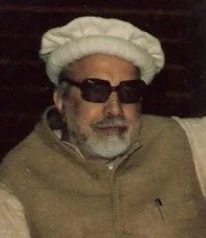
Ajmal Khattak was a Pakistani politician, writer, and Pashto language poet from the North-West Frontier Province. He served as the President of the Awami National Party and maintained a close friendship with Khan Abdul Wali Khan.
Early life and education
Born in Akora Khattak on 15 September 1925, Khattak was influenced by Bacha Khan during his childhood. He became an active member of the Quit India Movement by the age of 17. Although he attended Government High School in Peshawar, he eventually left his studies to participate more deeply in the movement. This decision marked the beginning of a political career that spanned over five decades.
He later returned to his education and earned a masters degree in Persian from Peshawar University. At Islamia College, Peshawar, he worked as a pioneer to modernize Pashto literature. He linked the language to European traditions—specifically English literature—to provide a new direction for progressive poetry. Khattak also served as an editor for several periodicals, including Anjam and Shahbaz.
Career
Khattak's political journey began with the Khudai Khidmatgar movement and continued through the National Awami Party (NAP). He served as the secretary general of the NAP from 1969 to 1973. During his tenure, he acted as an organizer at the United Democratic Front rally in Rawalpindi on 23 March 1973. This event resulted in violence when shots were fired at leaders such as Khan Abdul Wali Khan.
Following a government crackdown against the NAP, Khattak fled to Kabul to avoid arrest by the Federal Security Force. He lived in self-imposed exile in Afghanistan for 16 years while remaining associated with the Pakhtunistan movement. During this period, he maintained relations with leaders like Nur Muhammad Taraki and Dr. Mohammad Najibullah. He finally ended his exile in 1989.
In the 1990 general election, Khattak was elected to the National Assembly from Nowshera after defeating Pervez Khattak. He assumed the presidency of the Awami National Party following the retirement of Wali Khan. While he lost his re-election bid in 1993, he was nominated to the Senate of Pakistan in March 1994. His leadership was defined by shifting alliances, including a brief period leading the Pakistan Oppressed Nations Movement (PONM).
A power struggle occurred in 2000 between Khattak and Nasim Wali Khan. This conflict led him to briefly form a breakaway group called the National Awami Party of Pakistan. His new party was routed in the 2002 elections during the Muttahida Majlis-e-Amal sweep. He rejoined the ANP shortly after and retired from active politics in 2003 to serve as party patron in chief.
Personal life
Khattak resided in his native village of Akora Khattak during his retirement years. He passed away at a local hospital in Peshawar on 7 February 2010 at the age of 85. His burial took place one day after his death. On 12 May 2012, unknown militants destroyed his shrine in Akora Khattak village.
Awards and recognition
As a committed Marxist-Leninist, Khattak authored 13 books in Pashto and Urdu. His literary contributions include works such as Batoor and Da Ghirat Chagha. In 2006, the Torlandi Pukhto Adabi Tolana conferred the title of Baba-e-Nazam upon him. The South Asian Studies Department at the University of Pennsylvania has also translated his works into English.
He received the Kamal-e-Funn Award in 2007 from the Pakistan Academy of Letters. Khattak notably refused the Sitara-i-Imtiaz award in November 2006 after being informed by the government that he was in line for the honor.