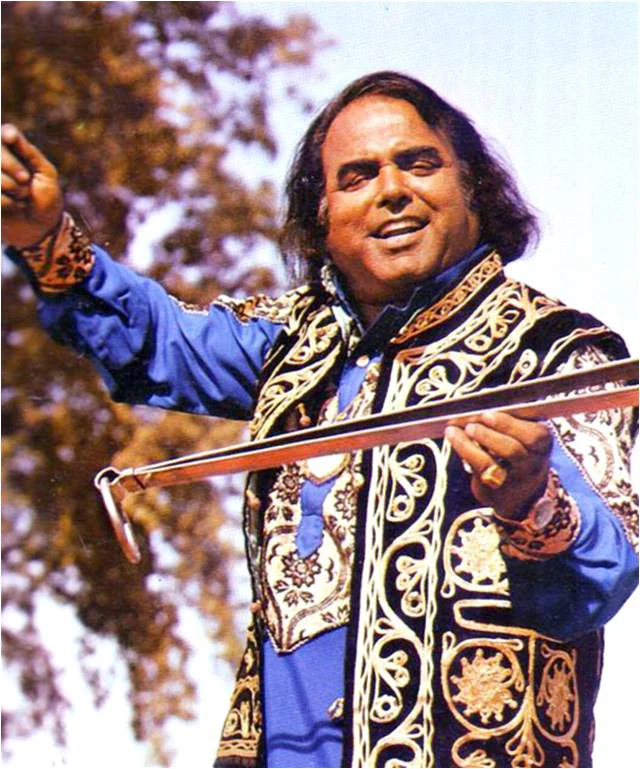
Alam Lohar is a Pakistani Punjabi folk music singer who remains widely regarded as the greatest singer of Punjabi folk music. He is credited with creating and popularising the Jugni genre through his unique narrative devices.
Early life and education
Lohar was born in 1928 in Achh, which is located near Kotla Arab Ali Khan in the Gujrat District of Punjab, British India. He belonged to a Punjabi Muslim family of Lohars, or blacksmiths. As a child, he read Sufiana Kalaam. This collection consists of Punjabi stories and poetry that shaped his musical foundation.
He started singing at a very young age. During his childhood, he participated in local gatherings where he expressed a vocal only art form by reading passages from great poets. He regularly attended festivals and gatherings to perform Sufi poetry and Punjabi folk stories.
Career
Lohar modified a new style of singing the Punjabi Vaar, which is an epic or a folk tale. This innovation made him popular when he toured various villages and towns throughout the Punjab region. He achieved fame for his rendition of Waris Shah's Heer along with songs such as Saif ul Maluk. His career saw significant commercial success through recordings with EMI/His Master's Voice Pakistan and other regional companies.
He recorded his first album at the age of 13. Throughout his professional life, he accomplished 15 Gold Disc LPs. His notable recorded works include Qissa Dhulla Bhatti (1959), Qissa Yusuf Zulaykha (1961), Qissa Hirni (1963), Bol Mitti de Bawa (1964), Jugni (1965), Qissa Mirza Sahiban (1967), Mirza De Maa (1968), Heer (1969), Maa Da Pyaar (1971), Qissa Sassi Pannu (1972), Jis Din Mera Vayaah Howega (1973), Qissa Baraa Maa (1974), Dilwala Dukhra (1975), and Wajan Mariyan Bulaya (1977). The song Wajan Mariyan Bulaya was written in memory of an accident where he sustained a leg injury.
During the 1970s, Lohar rose to become one of the notable singers in South Asia. He began touring different countries to entertain South Asian communities living abroad. These international tours included visits to the United Kingdom, Canada, Norway, the United States and Germany.
He dominated folk singing in Pakistan from the 1950s until his death in 1979. His musical style often featured a high pitch vocal accompanied by the Jhori (double flute) and the Chimta. He is particularly noted for bringing the story of Mirza Sahiban into a song format using this distinct method.
Lohar died in an accident near Sham ki Bhattian on 3 July 1979. A heavily loaded truck collided with his vehicle because the truck failed to overtake his car. He was buried at the outskirts of Lalamusa on GT Road in Pakistan.
Personal life
Lohar had eight sons. One of these sons, Arif Lohar, followed his father's tradition and is also regarded as a famous folk singer in Pakistan. The legacy of his music continues through various cultural tributes. The Government of Pakistan named a road 'Alam Lohar Road' which runs from his birth village Aach to the main Grand Truck Road. Additionally, a visual theatre depiction of his performance is on display at the Lok Virsa Museum in Islamabad.
Awards and recognition
He received the Pride of Performance Award from the President of Pakistan in 1979. Many famous singers including Noor Jehan, Nusrat Fateh Ali Khan and Lal Chand Yamla Jatt expressed sadness regarding his passing during a television broadcast on the 10th anniversary of his death.