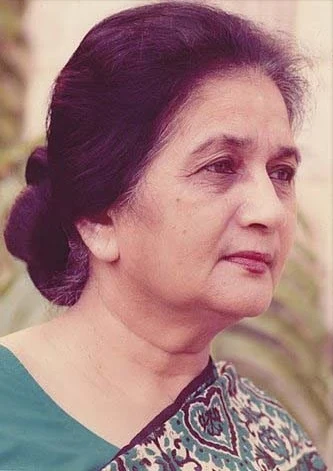
Ada Jafri was a prominent Pakistani poet and author who is widely regarded as the first major female Urdu poet to be published. Often called "The First Lady of Urdu Poetry," she remained a significant figure in contemporary Urdu literature throughout her life. She received numerous honors from the Government of Pakistan and various international literary societies.
Early life and education
Ada Jafri was born as Aziz Jahan on 22 August 1924, in Badayun, U.P. Her father, Maulvi Badrul Hasan, died when she was only three years old. Because of this loss, her mother reared her. She began composing poetry at the age of twelve under the pen name Ada Badayuni. During these formative years, she lived within impassable social bounds.
She later became a student of notable poets such as Akhtar Sheerani and Jafar Ali Khan Asar Lakhnavi. These men helped her by checking and correcting her poetry. Although she grew up in a traditionally conservative society, she remained bold enough to express herself through modern art.
Career
Jafri's literary journey began in 1945 when her first ghazal appeared in the magazine Romān. She published her debut collection of poems, "Maiṉ Sāz Ḍhūṉḍtī Rahī," in 1950. By that same year, she was recognized as the First Lady of Urdu Poetry. Her work primarily focuses on ghazals, but she also experimented with Urdu Haiku and āzād naz̤m.
Her writing style often utilizes a gender-neutral mode to discuss feminist themes. She addressed topics such as the dehumanisation of women and the tendency to view them as sexual objects. While she wrote about her experiences as a wife and mother, she did so using a modified traditional idiom. Critics note that her personality remains largely absent from her verses, which are instead characterized by a politeness of expression.
Jafri was a prolific writer who produced many different types of texts. She published five collections of Urdu poetry, including S̲h̲ahr-i Dard and Mausam, Mausam. In 1987, she released G̲h̲azal Numā, which contains short essays and biographies of previous Urdu poets. Her bibliography also includes her autobiography, "Jo Rahī so BeK̲h̲abrī Rahī," and 40 research papers.
One of her ghazals, "Hoṉṭoṉ pih kabhī un ke merā nām hī āʾe," became widely popular after it was sung by Ustad Amanat Ali Khan. She also mastered the art of writing maẓāmīn. Her ability to combine old and new thoughts earned her high praise from critics like Jazib Qureshi.
Personal life
She married Nurul Hasan Jafarey on 29 January 1947, in Lucknow, India. After this marriage, she adopted the pen name Ada Jafarey. Her husband was a top-ranking civil servant and a littérateur who wrote columns for English and Urdu newspapers. He also served as the president of the Anjuman-i Taraqqi-i Urdu. Following the independence of Pakistan in 1947, she moved to Karachi with her husband.
The couple had three children named Sabiha, Azmi, and Aamir. Sabiha Jafarey lives in the United States with her husband Zubair Iqbal and their three children. Azmi Jafarey resides in Massachusetts with his wife Shua and their two sons. Ada Jafri lived in Karachi with her son Aamir, his wife Maha, and their daughter Asra until her death.
Nurul Hasan Jafarey served as a major inspiration for her writing until he died on 3 December 1995. In her later years, she traveled frequently between Karachi and Toronto to promote the Urdu language. She passed away on 12 March 2015 at a hospital in Karachi at the age of 90. Her funeral was held at the Al-Hilal Mosque, and she was buried in the PECHS graveyard on 13 March 2015.
Awards and recognition
Jafri received several prestigious honors throughout her long career. In 1955, the Hamdard Foundation of New Delhi named her the "Outstanding Female Poet of the Century." She won the Adamjee Literary Award in 1967 for her collection S̲h̲ahr-i Dard. The Government of Pakistan later awarded her the Medal of Excellence in 1981.
She earned the Baba-e Urdu, Dr. Maulvi Abdul Haq Award in 1994 and the Quaid-e Azam Literary Award in 1997. In 2003, the Government of Pakistan conferred the Pride of Performance Award for Literature upon her. She also became the first woman to receive the Kamal-e Fan Award from the Pakistan Academy of Letters. International literary societies in Europe and North America also provided her with various awards.