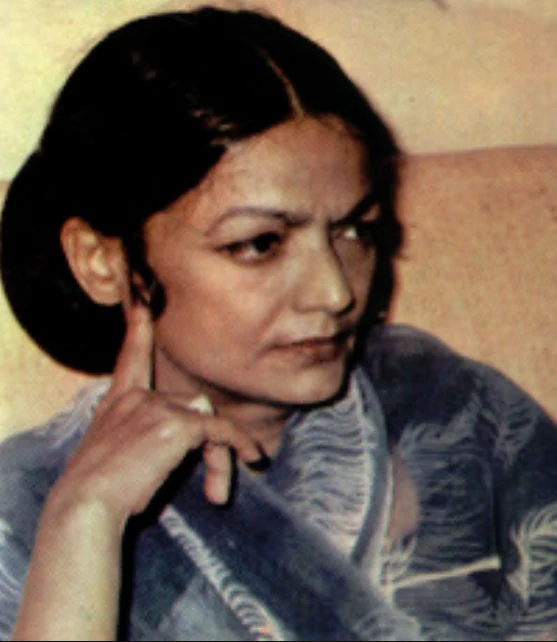
Khadija Mastoor is a renowned Pakistani Urdu-language novelist and short story writer. She is best known for her 1962 masterpiece Aangan, which remains a significant work in Urdu literature.
Early life and education
Khadija Mastoor was born on 11 December 1927 in Bareilly, British India. Her father, Tahawwur Ahmad Khan, worked as a doctor and a government employee. Because her mother, Anwar Jahan Begum, was an educated woman who published articles in women's magazines, the household maintained a literary atmosphere. This environment influenced her and her younger sister, Hajra Masroor, to develop an interest in writing stories at a young age.
The sisters saw their early stories published in children's magazines. These publications motivated Khadija to pursue writing as she grew older. Her work eventually appeared in prominent literary magazines such as Saqi, Adabi Duniya, and Aam-Gir. These outlets helped her establish a unique identity within the literary community.
Life became difficult after her father died during her childhood. Her mother later married Mohammad Mustafa Khan, who was the father of her step-brother, the poet Khalid Ahmad. Following the creation of Pakistan, her mother and siblings moved to Lahore. During this period, the family received immense support from Ahmad Nadeem Qasmi.
Career
Mastoor began writing short stories in 1942 and continued this practice until her death. She published five collections of short stories and two novels during her lifetime. Her narratives focused on political themes as well as social and moral values. She relied on observation and personal experience to craft her prose.
Her 1962 novel Aangan is regarded as one of the finest works in Urdu literature. This defining work has been translated into 13 languages. Neelam Hussain translated the book into English as The Inner Courtyard in 2001, while Daisy Rockwell released a version titled The Women's Courtyard in 2018. Penguin Books has recognized the novel as a classic.
The novel also found success on television. A Pakistani series based on the book aired on Hum TV from 2018 to 2019. This adaptation featured actors such as Mawra Hocane, Ahad Raza Mir, Ahsan Khan, and Sajal Aly. The broadcast sparked renewed interest in her writing, which helped the novel become a bestseller in Pakistan in 2019.
Her short-story bibliography includes Khail (1944), Bochaar (1946), Chand Roz Aur (1951), Thake Haare (1962), and Thanda Mitha Pani (1981). She also authored the novel Zameen, which was published in 1983.
Personal life
In 1950, she married Zaheer Babar Awan, who was a renowned journalist and the nephew of Qasmi. The couple had two children, Kiran Fayyaz and Pervez Alam Awan. She maintained a successful marriage while continuing her literary contributions.
Mastoor died at the age of 54 on 25 July 1982 in London, England. She was later buried in Lahore, Pakistan. At an event held at the Karachi Arts Council in 2005, scholar Sahar Ansari noted that Mastoor wrote based on her personal experiences.
Awards and recognition
She received the Adamjee Literary Award in 1963 for her novel Aangan. Her short-story collection Thanda Mitha Pani won the Hijra Award in 1981. These honors reflect her standing among Urdu writers.