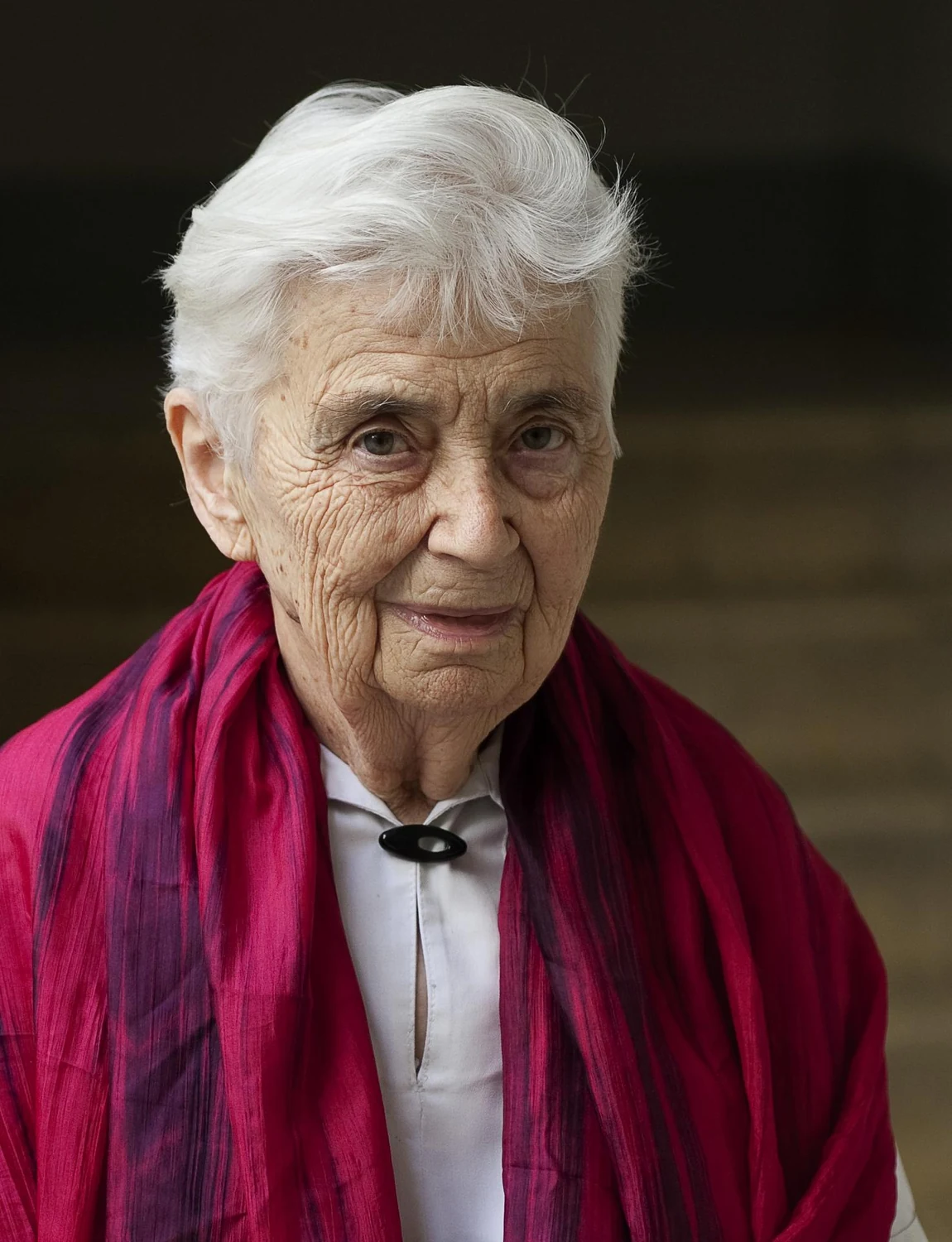
Ruth Katherina Martha Pfau was a German–Pakistani physician and Catholic religious sister who dedicated over 55 years to fighting leprosy in Pakistan. She served as a member of the Society of the Daughters of the Heart of Mary. Her extensive medical work led to the establishment of 157 leprosy clinics across the country.
Early life and education
Pfau was born on 9 September 1929 in Leipzig, Germany, to Lutheran Christian parents. She grew up with four sisters and one brother. During World War II, a bombing destroyed her family home. After the Soviet occupation of East Germany, she moved to West Germany with her family and decided to pursue medicine.
She studied medicine at the University of Mainz during the 1950s. While studying, Pfau met a Dutch Christian woman who had survived a concentration camp. This encounter influenced her path, leading her to leave a romantic association with a fellow student. She became involved in philosophy and classical literature discussions in Mainz. After completing her clinical examination, she moved to Marburg for further clinical studies. She was baptized as an Evangelical Protestant in 1951, but she converted to Roman Catholicism in 1953. Pfau credited Saint Thomas Aquinas with teaching her the courage of being human.
In 1957, she traveled to Paris and joined the Daughters of the Heart of Mary. This Catholic order later intended to send her to southern India. However, a visa issue in 1960 forced her to remain in Karachi.
Career
At age 31, Pfau decided to commit her life to the people of Pakistan and the battle against leprosy. She visited the Lepers' Colony near McLeod Road in Karachi by chance. This visit inspired her to start medical treatment for patients within a small hut. She eventually helped found the Marie Adelaide Leprosy Centre, which later expanded to include programs for blindness prevention and tuberculosis. In April 1963, she bought a leprosy clinic that served patients from Karachi, Pakistan, and Afghanistan.
Pfau was appointed as the Federal Advisor on Leprosy to the Ministry of Health and Social Welfare in 1979. She traveled to remote areas where medical facilities were non-existent. To fund these efforts, she collected donations in both Germany and Pakistan. Her work helped the World Health Organization declare Pakistan one of the first Asian countries to control leprosy in 1996. According to the Dawn, nationwide leprosy cases dropped from 19,398 in the early 1980s to 531 in 2016.
She was awarded Pakistani citizenship in 1988. Pfau died on 10 August 2017 at the Aga Khan University Hospital in Karachi. She had been admitted on 4 August 2017 due to respiratory problems. Although doctors placed her on a ventilator on 6 August, she refused life support to ensure a natural death. She was buried with full state honours at Gora Qabaristan.
Personal life
Pfau was highly respected by the Muslim majority in Pakistan because most of her patients were Muslim. While she never spoke about religion, observers noted that her service demonstrated a spirit of inter-religious dialogue. In 2018, her private residence in Karachi was converted into a museum to display her personal possessions.
Awards and recognition
Pfau received several prestigious honors for her humanitarian work. On 23 March 1989, President Ghulam Ishaq Khan presented her with the Hilal-i-Pakistan. She was also awarded the Hilal-i-Imtiaz, Nishan-i-Quaid-i-Azam, and the Sitara-i-Quaid-i-Azam. In 2006, City FM89 named her the Woman of the Year. On 14 August 2010, President Asif Ali Zardari awarded her the Nishan-i-Quaid-i-Azam for her public service.
Other recognitions include the Knight Commander's Cross of the Order of Merit of the Federal Republic of Germany and the Ramon Magsaysay Award. She also received the Albert Schweitzer prize and the Klaus Hemmerle Award. In Karachi, the Fazaia Ruth Pfau Medical College and the Dr. Ruth Pfau Hospital were named in her honor.