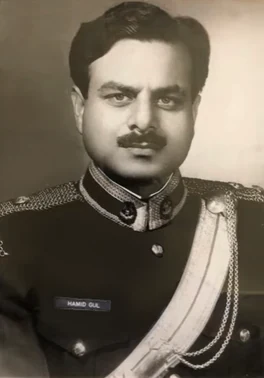
Hamid Gul was a Pakistani military officer and defence analyst who served as a three-star general. He is best known for his tenure as the Director-General of the Inter-Services Intelligence (ISI) between 1987 and 1989. During this period, he directed ISI support to the Afghan mujahideen against Soviet forces in cooperation with the CIA.
Early life and education
Hamid Gul was born on 20 November 1936 in Sargodha within the Punjab Province of British India. He belonged to a Punjabi-Pashtun family, as his parents, Muhammad Khan and his wife, originated from Buner Tehsil in the Swat District. His ancestry traces back to the Yusufzai tribe of Pashtuns.
His father served as a Subedar-major in the British Indian Army. This man moved from Swat to Lahore before eventually settling in Sargodha to manage arable land. The family history includes significant political and religious involvement, as his grandfather was an activist for the Khilafat Movement. His great-grandfather, Faiz Khan, participated in the jihad of Shah Ismail Dehlvi and Syed Ahmad Barelvi.
Gul received his early education at a local school in his village. He later gained admission to Government College Lahore. Following this, he attended the Pakistan Military Academy Kakul.
Career
Gul was commissioned into the Pakistan Army in October 1956 as part of the 18th PMA Long Course. He served in the 19th Lancers regiment of the Armoured Corps. During the 1965 war with India, he acted as a squadron commander. He attended the Command and Staff College Quetta during the 1968–69 period.
Between 1972 and 1976, Gul served directly under General Muhammad Zia-ul-Haq. He held roles as a battalion commander and later as a Staff Colonel while General Zia was GOC of the 1st Armoured Division. These years cemented his professional ties with General Zia. After being promoted to Brigadier in 1978, he became the Martial Law Administrator of Bahawalpur. He also served as the Commander of the 1st Armoured Division in Multan in 1982.
General Zia nominated Gul to succeed General Akhtar Abdur Rahman as the ISI chief in March 1987. While leading the agency, he planned the spring 1989 operation to capture Jalalabad from the Soviet-backed Afghan army. This move aimed to install a resistance-backed government with Abdul Rasul Sayyaf as Prime Minister and Gulbuddin Hekmatyar as Foreign Minister. However, the battle failed to yield the expected results and led to his replacement by Shamsur Rahman Kallu in May 1989. Following this, Prime Minister Benazir Bhutto transferred him to serve as the commander of the II Corps in Multan.
In November–December 1989, Gul conducted the Zarb-e-Momin military exercise. This event represented the largest show of force by the Pakistan Armed Forces since the 1971 war. In August 1991, General Asif Nawaz attempted to transfer Gul to the position of DG Heavy Industries Taxila. Gul refused this assignment and was subsequently retired from the army.
Gul played a significant role in domestic politics by helping form the Islami Jamhoori Ittehad (IJI). This conservative political alliance was created with the support of Generals Aslam Beg and Asad Durrani to oppose the Pakistan Peoples Party. He appointed Nawaz Sharif as the leader of the IJI, which helped secure Sharif's rise to power. The ISI provided ₨15 million in funding to help this alliance compete in the elections.
Personal life
Hamid Gul died on 15 August 2015 after he suffered a brain haemorrhage. He earned various nicknames during his career, including "Father of the Taliban." The United States accused him of having ties to Islamic terrorist groups such as Al-Qaeda and Lashkar-e-Taiba.
Awards and recognition
A. S. Dulat, the former director of R&AW, described Gul as the most dangerous and infamous ISI chief in Indian eyes. He was widely recognized for his influence on Pakistani geostrategic policies. Some observers credited him with expanding covert support to Kashmiri militants from 1989 onwards.