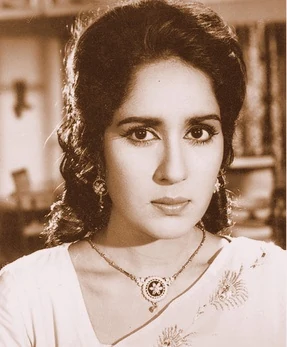
Shamim Ara was a prominent Pakistani film actress, director, and producer who shaped the landscape of Lollywood. Known as "The Tragic Beauty" for her frequent portrayal of tragic heroines, she remained a highly successful figure throughout the 1960s, 1970s, 1980s, and 1990s. She is regarded as one of the most influential actresses in the history of Pakistani cinema.
Early life and education
Ara was born as Putli Bai on 22 March 1938 in Aligarh, Uttar Pradesh, within British India. Her mother worked as a professional dancer and encouraged her interest in both acting and dancing. A maternal grandmother acted as her guardian and made the primary decisions regarding her early life and career path. Following the partition of India, the family relocated to Karachi in 1956.
Career
In 1956, while visiting relatives in Lahore, Ara had a chance meeting with director Najam Naqvi. He was searching for a new face for his film Kanwari Bewah (1956) and felt impressed by her sweet voice and innocent smile. Naqvi gave her the stage name Shamim Ara because her birth name resembled an infamous dacoit. Although her debut film did not attract many viewers, she quickly emerged as a rising star in the industry.
She secured her first prominent role in 1958 when she played Surayya in Anwar Kamal Pasha's Anarkali alongside Noor Jehan. While films like Waah Re Zamanay and Raaz failed to achieve major box office success, her career changed in 1960. She played an amnesiac bride in S. M. Yusuf's Saheli, which served as her professional breakthrough. In 1962, she appeared in Qaidi as a woman waiting for her beloved. This film featured the ghazal "Mujh Se Pehli Si Mohabbat Mere Mehboob Na Maang," which was picturized on her while Noor Jehan provided the vocals.
Ara became a household name and earned the title role in Naila in 1965. This production was the first color film produced in West Pakistan, and her performance as the tragic Naila earned critical acclaim. She starred in numerous hits such as Devdas, Doraha, and Hamraz. Landmark films including Chingari (1964), Aag Ka Darya (1966), and Saiqa (1968) helped secure her position as the top actress of the 1960s. She performed in only two Punjabi movies, which were Jaidaad (1959) and Tees Maar Khan (1989).
She retired from acting as a leading lady in the early 1970s to pursue other roles. In 1968, she produced her first film, Saiqa, which was based on a novel by Razia Butt. As a director, she made her debut with Jeo Aur Jeenay Do in 1976. She directed many films including Miss Hong Kong (1979), Lady Smuggler (1987), and Love 95 (1996). According to screenwriter Vasay Chaudhry, her "Miss" franchise was a major contribution because she mastered commercial film formulae.
Personal life
Ara married four times during her life. Her first husband was Sardar Rind, a landlord from Balochistan who died in a car accident. She later married Abdul Majid Carim, the scion of the Agfa Color Film Company family, with whom she had one son named Salman Majid Carim. This marriage ended in divorce. Her third marriage to director Fareed Ahmed lasted only three days before they divorced.
Her final marriage was to writer and director Dabeer-ul-Hassan. The family lived in Lahore until 2005, when she and Salman Majid Carim moved to London. Ara's health declined after a stroke in 2001 and a brain hemorrhage on 19 October 2010. She remained in a coma for six years while being cared for by her son. She died on 5 August 2016 in a London hospital after a prolonged illness.
Awards and recognition
Ara won two consecutive Nigar Awards as Best Director for her work on Haathi Mere Saathi and Aakhri Mujra. Following her passing, several celebrities including Nadeem and Mustafa Qureshi offered tributes. The Pakistan National Council of Arts held a special event in September 2016 to honor her legacy.