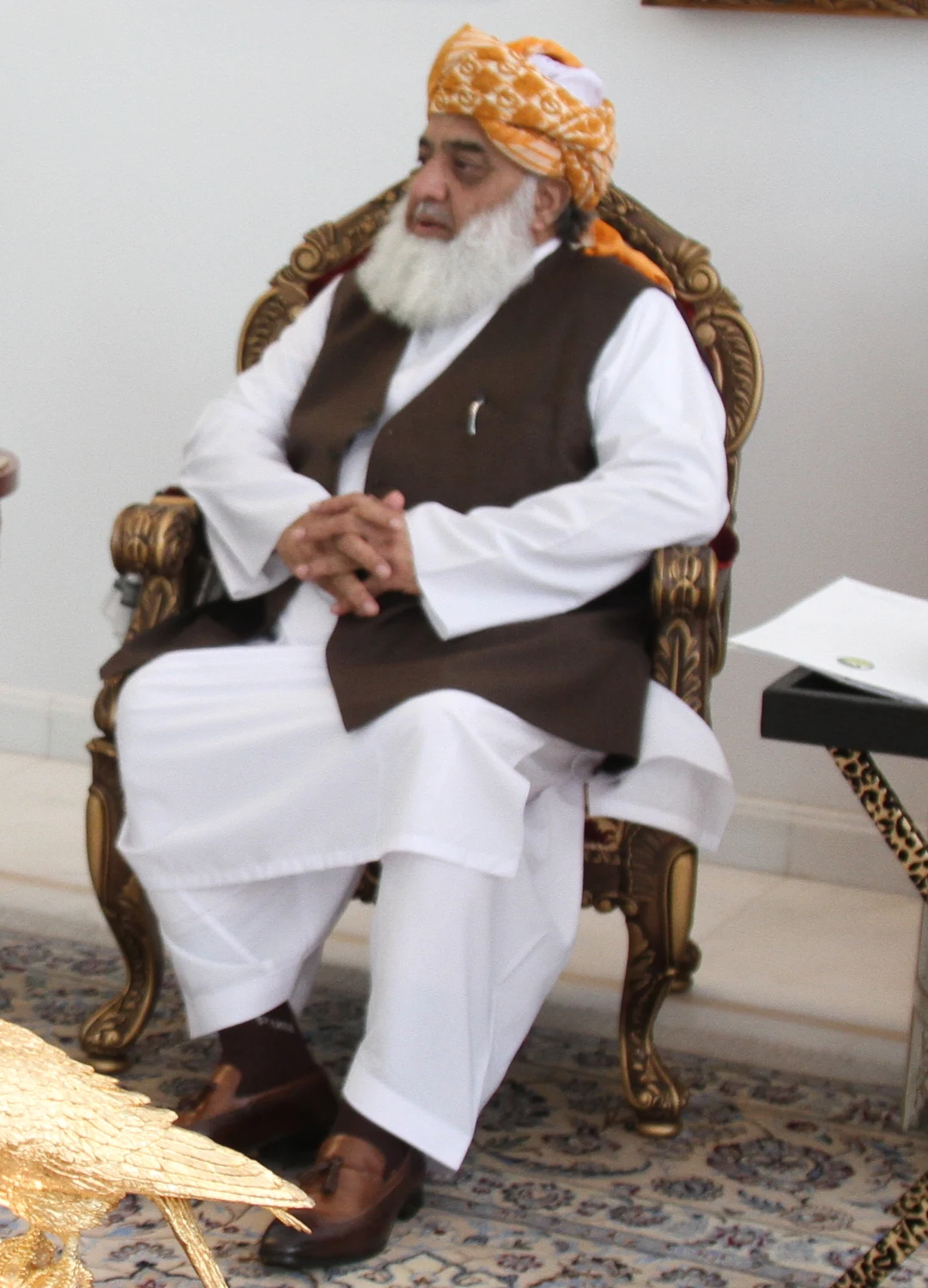
Fazal-ur-Rehman is a Pakistani Islamic scholar and politician who serves as the president of Jamiat Ulema-e-Islam (F). He currently holds a seat in the National Assembly after being elected in February 2024.
Early life and education
Rehman was born on 19 June 1953 in the village of Abdul Khel, located in Dera Ismail Khan. While one report suggests his birth date was 1 September, official records cite 19 June 1953. He was raised in a Pashtun family and is the son of Mufti Mahmud. His father served as the Chief Minister of Khyber Pakhtunkhwa between 1972 and 1973.
He attended high school in Multan where he studied under Mussarat Baig and Syed Iqbal Shah. After his secondary schooling, he earned a Bachelor's degree from the University of Peshawar in 1983. He later completed a Master's degree at Al-Azhar University in Cairo.
His religious training involved studying Arabic grammar and Islamic logic under Mufti Muhammad Essa Gurmani and Molana Abdul Ghaffor Gurmani. He also studied with Muhammad Ameer of Chudwan in a Multan madrassa. During his Shahadat-ul Alamia at Darul Uloom Haqqania, he was a student of Abdul Haq Akorwi, Hasan Jan, and Syed Sher Ali Shah. He completed his Dars-i Nizami with distinction in 1979.
Career
Rehman entered politics in 1980 when he became the secretary general of Jamiat Ulema-e-Islam at age 27. This appointment followed the death of his father, Mufti Mehmood. He faced multiple arrests during the martial law of General Zia ul Haq between 1980 and 1985. During the 1980s, he participated in the Movement for the Restoration of Democracy to oppose the military regime.
The Jamiat Ulema-e-Islam split into two factions during the mid-1980s, with Rehman leading the Jamiat Ulema-e-Islam (F) wing. He won his first seat in the National Assembly during the 1988 general elections from D.I. Khan. Although he lost the 1990 election, he returned to the National Assembly in 1993 on an Islamic Jamhoori Mahaz ticket. During this period, he served as the Chairman of the Standing Committee for Foreign Affairs.
He secured his third term in the 2002 general elections through the Muttahida Majlis-e-Amal ticket. While he was a potential candidate for prime minister, he was not appointed to the role. He served as the Leader of the Opposition from 2004 to 2007. During his party's time in power in Khyber Pakhtunkhwa, they passed the 'Hasba Bill', but Chief Justice Iftikhar Chaudhry later declared it unconstitutional.
In the 2008 elections, he was elected from the Bannu constituency while losing his traditional seat in D.I. Khan. He held several high-level positions, including chairman of the Kashmir committee and federal minister under Prime Ministers Nawaz Sharif and Shahid Khaqan Abbasi. Following a defeat in the 2018 general elections, he lost his seat in the National Assembly. However, he led the Pakistan Democratic Movement (PDM) to oust Imran Khan via a no-confidence motion in 2022.
Rehman has maintained a controversial political stance regarding various social issues. He opposed the Huqooq-e-Niswan bill and the Women's Protection Bill in 2016. He also led the Azadi March from Karachi to Islamabad in late 2019 to demand the resignation of Imran Khan.
Personal life
Rehman is the son of the late Mufti Mahmud, a prominent Deobandi scholar and politician. He follows the teachings of Mahmud Hasan Deobandi, who campaigned against the British Raj. While he has been described as an extremist by some due to his ties to the Islamic Emirate of Afghanistan, he has attempted to re-brand himself as a moderate. He opposes armed struggle to impose sharia laws because he believes it leads to societal extremism.
In October 2001, Pervez Musharraf placed him under house arrest in Abdul Khel for allegedly inciting citizens against the armed forces. He was released in March 2002 after the cases against him were withdrawn.