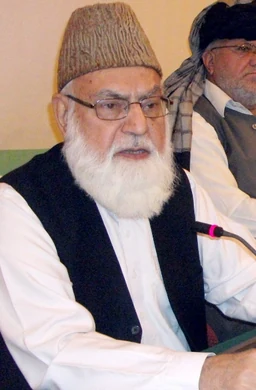
Qazi Hussain Ahmad is an Islamic scholar and a pro-Islamic democracy activist who served as the Emir of Jamaat-e-Islami. He led the social conservative Islamist political party for nearly 22 years while representing various interests in the Pakistani Parliament.
Early life and education
Ahmad was born on 12 January 1938 to ethnic Pashtun parents. His birth took place at the house of Muhammad Abdul Rab in Ziarat Kaka Sahib, located within the Nowshera District of Khyber-Pakhtunkhwa. He was the youngest of 10 siblings.
After he completed his early education at home, Ahmad entered Islamia College, Peshawar. He later earned a Master of Science (MSc) degree in geography from Peshawar University. Before entering politics, he worked as a lecturer at Jehanzeb College Swat for 3 years. Following this teaching period, he started his own business and served as the vice-president of the Khyber-Pakhtunkhwa Provincial Chamber of Commerce and Industry.
Career
His involvement with the Islamic Movement began during his school days when he joined Islami Jamiat-e-Talaba, Pakistan. He became a member of Jamaat-e-Islami in 1970 and subsequently held the position of President for its Peshawar branch. After serving as Secretary and Ameer of the Khyber-Pakhtunkhwa provincial branch, he was promoted to Secretary General of Jamaat-e-Islami Pakistan in 1978.
Ahmad was elected as the Ameer (Chief) of Jamaat-e-Islami Pakistan in 1987. He maintained this leadership role through four additional re-elections in 1992, 1994, 1999, and 2003. In 2008, he chose not to run for the office again, allowing Syed Munawwar Hasan to lead the party.
His legislative career included service in the Senate of Pakistan, where he was first elected in 1986 for a 6-year term. He secured re-election to the Senate in March 1992, but he resigned from that position in 1996 to protest the corrupt political system. Later, he was elected as a Member of National Assembly during the 2002 Pakistani general election representing his native town of Nowshera. He also acted as the parliamentary leader of Muttahida Majlis-e-Amal.
Ahmad engaged in international diplomacy to mediate various global conflicts. He traveled abroad to represent the Jamaat at international forums and worked on issues such as the Iran–Iraq War, the Persian Gulf War, and the Balkan crisis. He maintained close contact with Afghan mujahideen before the Soviet Union invaded Afghanistan. He helped build support in Pakistan for that movement and introduced the Afghan jihad to the outside world.
In 1996, he led significant political protests against the government of Benazir Bhutto. On 27 October 1996, Jamaat-e-Islami and other opposition parties began a long march to protest alleged corruption. This movement contributed to the dismissal of the Bhutto government by President Farooq Leghari on 4 November 1996.
Personal life
Ahmad was married and had two sons, Asif Luqman Qazi and Anas Farhan Qazi, along with two daughters. His wife and children are all known to be activists for Jamaat-e-Islami. He was a multilingual speaker who used Urdu, English, Arabic, and Persian in addition to his native Pashto.
He held a deep admiration for the poet Allama Muhammad Iqbal. Ahmad frequently included quotes from the Urdu and Persian poetry of Iqbal during his various speeches. He died of a heart attack on 5 January 2013 at a residence in Islamabad.