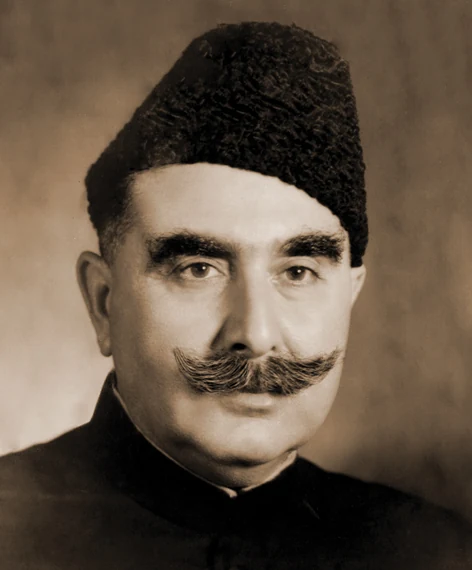
Sardar Abdur Rab Nishtar was a Pakistani independence activist and politician from the North-West Frontier Province. He held several high-ranking positions, including serving as the first Minister of Communications of Pakistan and the second Governor of West Punjab.
Early life and education
Nishtar was born on 13 June 1899 in Peshawar, British India. His father, Maulvi Abdul Hannan, belonged to the Pashtun Kakar tribe—a group that actively opposed British rule in South Asia. Although his ancestors originated from the Zhob district in north Balochistan, they eventually settled in Peshawar.
He completed his early schooling at Edwardes High School Kohati Gate Peshawar and later attended Sanathan Dharam High School in Bombay. After graduating from Edwardes College in Peshawar, he earned a Bachelor of Arts degree from Punjab University, Lahore, in 1923. He finished his formal education at Aligarh Muslim University, where he received an LL.B degree with honours in 1925.
Career
Nishtar participated in the Khilafat Movement alongside Maulana Muhammad Ali Jauhar from 1919 to 1920. He was a member of the Indian National Congress between 1927 and 1931, but he later joined the All-India Muslim League. From 1929 to 1938, he served as a Municipal Commissioner for the Peshawar Municipal committee.
His political influence grew as he became a confidante of Muhammad Ali Jinnah. He held several significant roles, including membership in the All India Muslim League Council from 1932 to 1936 and serving as the Finance Minister of the North-West Frontier Province between 1943 and 1945. In 1945, he represented the All India Muslim League at the Simla Conference.
Following the creation of Pakistan, he served as the Minister for Communications from August 1947 to August 1949. During this tenure, he introduced the use of the Urdu language within the Pakistan Post Office and Pakistan Railways. He was appointed Governor of Punjab in August 1949 after the dismissal of the provincial government. He managed the governorship until November 1951, which helped pave the way for an elected government.
Nishtar was considered a candidate for Prime Minister following the assassination of Liaqat Ali Khan. However, his appointment was blocked by liberal officials and senior secularists, such as Iskander Mirza, due to his conservative Islamic views. He later entered the opposition after protesting the dismissal of Prime Minister Khawaja Nazimuddin's government by Governor General Ghulam Muhammad.
In 1956, he was elected president of the Muslim League despite opposition from Iskander Mirza and Chaudhry Mohammad Ali. He continued to lead the Pakistan Muslim League as its president from 1956 until his death in 1958. He died of a heart attack on 14 February 1958 in Karachi, having suffered from high blood pressure and heart disease since 1953.
Personal life
Nishtar was known for his deep religious convictions and an interest in Islamic mysticism. His family included several notable figures, such as his brother Sardar Abdul Ghayur, who served as a senior diplomat. His nephew, General Abdul Waheed Kakar, formerly held the position of Chief of Army Staff.
His eldest son is Jamil Nishtar, a renowned banker, while another son is the physician Professor Dr Tariq Nishtar. His youngest son was an engineer who passed away at age 29. The politician's grandson is married to Dr. Sania Nishtar, who served as a special assistant to Prime Minister Imran Khan.
Awards and recognition
The Pakistan Post Office issued a commemorative postage stamp in his honor in 1990 as part of the 'Pioneers of Freedom' series. Several institutions bear his name, including Nishtar Medical College and Nishtar Hospital in Multan. He is also commemorated by Nishtar Hall in Peshawar, Nishtar Park, and Nishtar Road in Karachi.
Nishtar was buried at Mazar-e-Quaid near the Tomb of Muhammad Ali Jinnah to recognize his services to Pakistan. His political legacy remains tied to his efforts in fostering political consciousness among Muslims in the subcontinent.