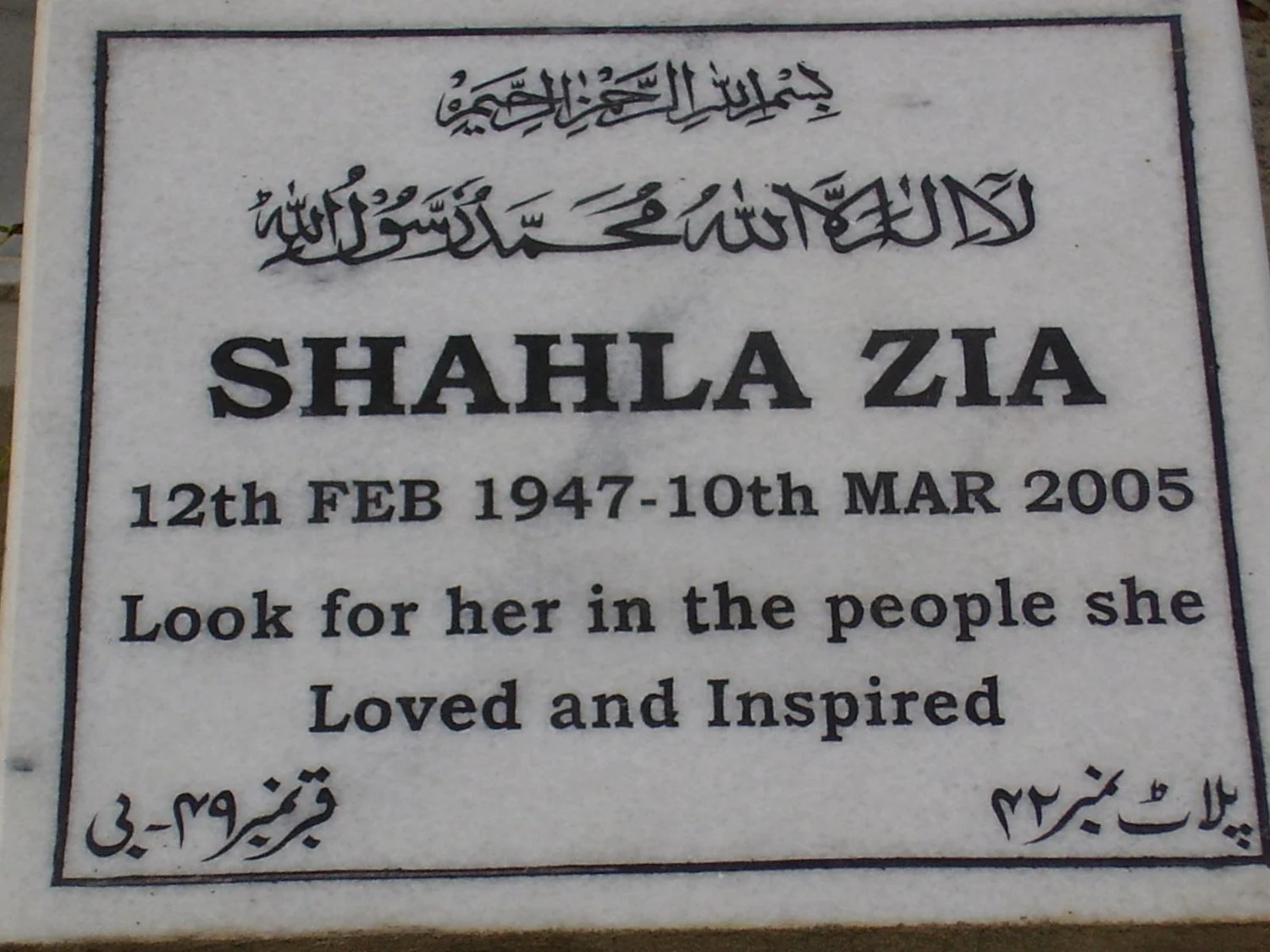
Shehla Zia is a Pakistani lawyer and activist who dedicated her life to women's rights. She gained recognition for challenging discriminatory laws through legal action and public protest.
Early life and education
Born on 12 February 1947, Zia grew up in a Punjabi Muslim family in Lahore. Her father, Mahmood Ali Khan, worked as an activist for the Pakistan movement. Her mother, Satnam Mahmood, was an educationist. These familial influences shaped her early years in Lahore.
She attended the University of the Punjab during the 1960s to pursue higher education. After completing her studies, she earned a bachelor's degree in law. This achievement made her one of the first Pakistani women to hold such a degree.
Career
Zia established herself as a prominent figure in legal activism by co-founding the Aurat Foundation with Nigar Ahmed. In 1980, she also helped found the AGHS women's law firm and legal aid centre. She remained an active member of the Women's Action Forum throughout her career.
Her commitment to justice led to significant personal risk. In 1983, Zia was imprisoned alongside several other women for protesting the 1983 Law of Evidence. This protest took place in front of the Lahore High Court because the law rendered the testimony of a male witness equal to that of two women under certain circumstances. She fought against laws that targeted both religious minorities and women.
The government appointed her to serve on a commission that examined the status of women in Pakistan. In 1997, she coauthored a report produced by this specific commission. Her involvement with state institutions changed when the Pakistani National Assembly approved Sharia law through the Fifteenth constitutional amendment in 1998. This political shift forced her to resign from several government bodies.
Zia also left a lasting impact on environmental jurisprudence. She acted as the named plaintiff in a 1994 case brought before the Pakistani Supreme Court. The legal challenge concerned the construction of an electric grid station that plaintiffs claimed posed health risks. This ruling became a landmark in Pakistani environmental law because it established that the right to a healthy environment is constitutionally protected. The court determined that this right falls within the right to life and dignity.
Personal life
Zia had five children, consisting of two sons and three daughters. Her daughter, Maliha Zia Lari, followed in her footsteps as a lawyer and human rights activist. She passed away on 10 March 2005 at the age of 58 following an illness.