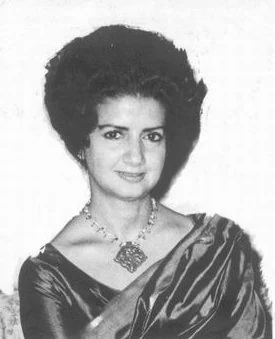
Zaib-un-Nissa Hamidullah was a pioneering Pakistani writer, journalist, and publisher who broke numerous gender barriers in her field. As the first female editor and publisher in Pakistan, she established herself as a leading voice in English-language journalism. Her influence extended to political commentary and international diplomacy, marking her as a central figure in the country's early media landscape.
Early life and education
Born on 25 December 1918 in Calcutta, Hamidullah grew up within a prominent literary family. Her father, S. Wajid Ali, was a writer and an avid nationalist who became the first person to translate the works of Muhammad Iqbal into Bengali. She lived in a household at 48, Jhowtalla Road that served as a meeting place for the Calcutta literary circle. This environment provided her with significant support from both her Bengali father and her English mother.
She attended the Loreto House Convent to complete her Senior Cambridge qualifications. As a child, she often turned to poetry to express her emotions during periods of loneliness. Her writing was later influenced by travels to rural areas in Bengal and the Punjab. In 1933, at the age of 15, she published her first poem in The Illustrated Weekly of India.
At age 18, she won a poetry competition sponsored by England's Daily Mirror. This achievement followed a poem she had previously published in The Star of India. This publication eventually became part of the Dawn group of papers where she would later write.
Career
Hamidullah first gained prominence in 1936 when her poetry was accepted by Bombay's Illustrated Weekly of India. She remained a regular contributor to this newspaper until the independence of 1947. In 1943, she published her first book of poetry titled Indian Bouquet through her father's publishing house. The first edition proved popular and sold all copies within three months. She later released another collection of poetry called Lotus Leaves.
A major turning point occurred in 1945 when she met Fatima Jinnah during the Simla Conference. This connection allowed Hamidullah to secure an exclusive interview with Muhammad Ali Jinnah, which brought her fame across India. Following independence, she began writing a column titled "Thru a Woman's Eyes" for the Karachi daily newspaper Dawn in December 1947. She eventually challenged the limited scope of this feature by demanding the right to comment on politics.
After receiving permission from editor Altaf Husain to write on the editorial page, she became Pakistan's first female political commentator. However, she left Dawn in 1951 after the editor requested she focus only on feminine concerns such as cooking or child-rearing. In 1952, she founded the monthly magazine The Mirror, which served as Pakistan's first social glossy magazine. Through this venture, she became the nation's first female editor and publisher.
Her professional reach extended to international platforms during the 1950s. In 1955, she traveled to Cairo as part of a press delegation and became the first woman to speak at Al-Azhar University. She also represented Pakistan at the United Nations, including serving as the deputy chief of the Pakistani delegation during the special 1970 session. In 1956, she published her travelogue Sixty Days in America, which was based on columns written for The Times of Karachi.
Personal life
In 1940, Hamidullah married Khalifa Muhammad Hamidullah, a man from a well-known Punjabi family. Their marriage was not an arranged union, and she moved to the Punjab Province to join him. She found it difficult to adjust to the lifestyle of his large family after being raised in an Anglo-Indian household. Her husband worked as an executive for the Bata shoe company and later headed its operations in Ireland in 1972.
The couple had two children, Nilofar and Yasmine. She dedicated all of her books to her husband as a sign of their devotion. During the independence period in 1947, she and her husband assisted refugees crossing the border from India.
Awards and recognition
Hamidullah's legacy is recognized through several civic honors and leadership roles. Zaibunnisa Street in Karachi was named in her honor to commemorate her contributions. She served as the first chapter-president of the Karachi branch of the Business and Professional Women's Foundation for two consecutive terms. Additionally, she was the first president of the Women's International Club of Karachi.